


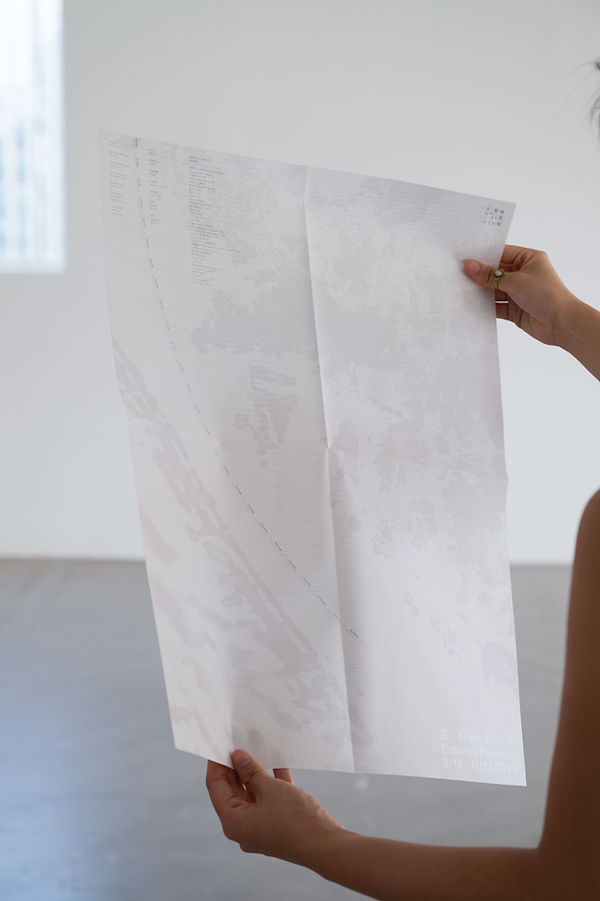

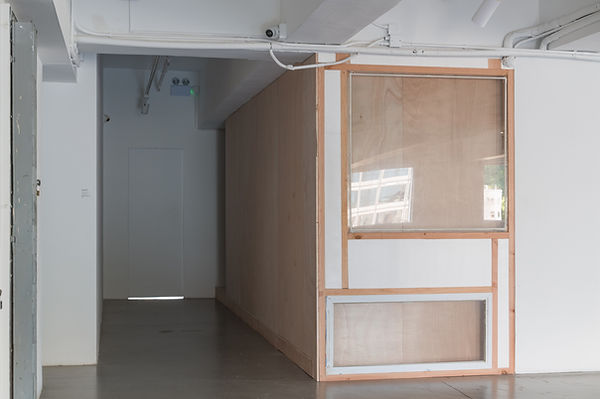
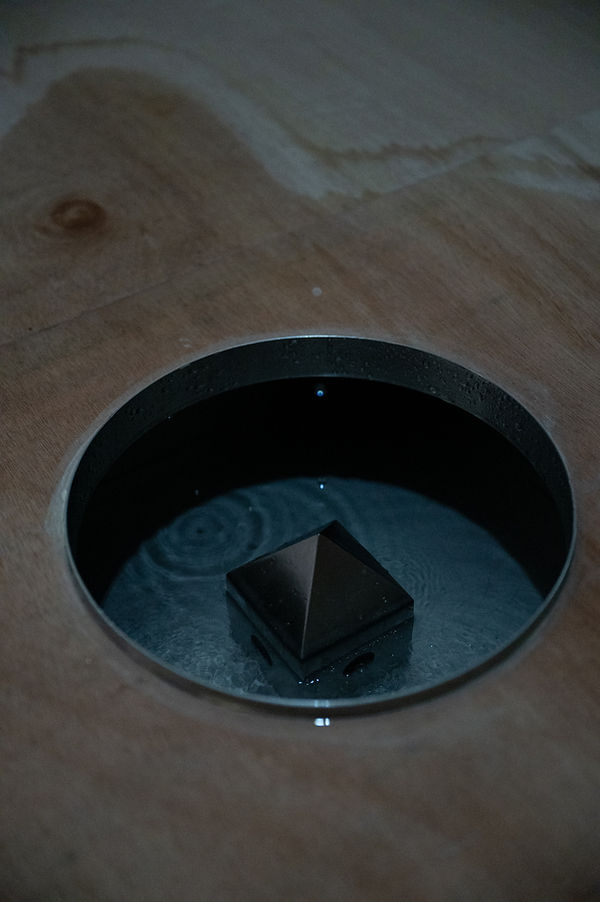


Photos (c) Felix SC Wong
∅, 2025
16mm film, automated dripping system, beer can, foam, projector, strobe light, water from dehumidifiers, window frames
Catastrophe bonds were introduced into the global capital market as a novel financial instrument in December 1996. Payouts are triggered when a catastrophic event crosses an ‘attachment point’ —a threshold of certain predefined risks, such as the magnitude of an earthquake or the degree of economic losses. Natural disasters would seem to be indifferent to financial markets and yet, in recent years, online conspiracy theories have suggested that since regulators first permitted trading to continue during extreme weather, the Hong Kong Observatory has become more liberal in issuing severe typhoon or black rain weather warnings. Confronted by unchecked capitalism, what security can possibly exist to insure us against the catastrophe of the system itself?
Can a trickle reverse a stream? Can a loss mitigate a loss? Catastrophes are catastrophes not because their destruction is unpredictable, but because they cut through the threshold from the improbable to the possible—they become part of the real, and reality has always been known to force our hand. Running out of fossil fuel is a catastrophe. Climate change is a catastrophe. The annihilation of children’s lives is a catastrophe. A tolerance of genocide is a catastrophe. The evidentiary strength of an image—its frame, light, form – exposes the immobility of the mind. When was the last time a catastrophic image changed your mind?
One of the first questions an insurer would ask when assessing a claim is what steps have been taken to mitigate risk. In this light, an unforeseen risk is not a fact of nature, but a bad plan or investment—a failure to anticipate. Projecting risk is an arduous and costly endeavour; it begins with building models to test various scenarios based on established theories, historical patterns and available data. However, the nature of high-intensity, low-frequency events means that some things will always fall outside the parameters of rational planning. What enters the exhibition space once every windowpane is removed? What is the point at which elements from the outside world tip into the inside space of an exhibition? The point at which the exhibition’s hermeneutic seal starts to dissolve? What would make us feel safer—air-conditioned microclimates, our attachment to security and progress, or the capacity for real change?
Our attempts to anticipate or calculate risk so often blur into a feedback loop of noise from our illusions and fears. How long can we sustain our complicity in and capital’s indifference to climate change? What would it take for us to reach a threshold to pause, reflect and re-evaluate everything anew?
The exhibition is a container for all of these realities to enter.
Jaime Chu
-
Pratchaya Phinthong: ‘Empty Set’
13 September–23 November 2025
Throughout our conversations in preparation for Pratchaya Phinthong’s intervention into Para Site’s physical space, I’ve had on my mind the Chernobyl exclusion zone—a territory abandoned due to the release of radioactive contamination after the nuclear disaster in 1986. In the absence of human activity, the rehabilitative forces of nature have started to reassert themselves over the land. I’ve come to see Phinthong’s exhibition as a radical opening of Para Site’s potential as a space—an experiment that tests our ability to adapt to the ecological reality of a changing climate that we rarely take time to acknowledge, much less actively learn to resist. In this context, the exhibition is not about adaptation but rupture—a deliberate interruption to the way we operate as an art space in the age of climate change. Here, the functions of energy flows, objects and images become transformed into a radically different order.
Differentiating himself from earlier generations of Thai artists, Phinthong’s artistic language and identity deliberately resist legibility through conventional markers of being Thai (Buddhism, nation, monarchy). Phinthong doesn’t maintain a traditional studio space and has often explained that the closest he has to a studio is the park near his home—the same place where he regularly takes calls from people in the art world. In this spirit, his works draw on reality’s fragments and peripheries where human resilience of all kinds has left its trace, those liminal spaces where oppositional forces coexist in perpetual flux to one another, from the weight of fruit gathered by seasonal berry pickers, currency fluctuations, ad-hoc economies, a deserted 7-Eleven store, parking lots, to formless things such as online rumours and everyday serendipity.
For his exhibition in Hong Kong, Phinthong directs his interest to the region by bringing together existing and new works that trace phase shifts between different sources of energy and matter both inside and outside the exhibition pace. A proposal to set CH4*5.75H2O on fire (work in process) (#1) (2016–ongoing) is a 16mm film whose celluloid loop spans both the interior and exterior spaces of Para Site. CH4 · 5.75H2O, or methane hydrate, also known as ‘fire ice’, is a crystalline solid where methane molecules are trapped within a cage of water molecules. Phinthong uses it in the work to explore both the poetic image of burning ice, but also its role in unfolding geopolitical tensions shaping the region. Methane hydrate is touted as a future source for fossil fuel after large deposits were discovered within sediments deep below the ocean floor in recent years, containing more energy than all the world’s oil, coal and gas combined. Energy can be extracted from methane hydrate when water and methane are released through a decrease in pressure, resulting in temperature rises inside these ice-like structures. Heralded as a catalyst for economic growth, it is equally feared as a potential trigger to chain reactions that could lead to planetary meltdown. With poetic play, Phinthong has filmed the burning of ice until it exhausts its energy. The celluloid film reel of this image is then extended and looped into a circular journey that leads to the outside of the building and back into the projection room again. With each continuous run of the film, the image exposes itself to the conditions of the world outside, gradually wearing down. Nearby in the same compartmentalised structure made from various upcycled elements, water collected through a humidifier from the exhibition space forms a line of droplets that seemingly defy the laws of gravity: instead of falling, these droplets dance to a strobe light to magically rise from the ground up.
Phinthong is often described as a conceptual alchemist who doesn’t ‘invent’ something out of nothing, but instead creates from existing things and explores how they circulate in relation to one another. An alchemist looks to transmute a base material into something of higher value. Playing with ideas of equivalence and interchangeability, the artist takes elements from the real world and puts them into new relationships with the material world. In his works, these contrasting affinities orbit one another, a dynamic made possible by Phinthong’s ability to locate the unstable boundaries and cracks between the possibilities of artistic representation and what lies beyond this frame. Sometimes this interaction is understood as journeys where things meet one another and accumulate, and at other times imagined as correspondences between entities operating on divergent paths that would never otherwise meet. Artworks find form in the balance between equivalence and flux, in how materials and social relations find themselves together and the dynamics of how they meet to govern exchanges among language, economic values, cultural meaning and geographies.
A way of denoting ‘nothingness’, an empty set (∅) is typically a circle with a diagonal dash, an absence with defined boundaries yet containing no elements. It can be used functionally or symbolically to account for potential, negation or a void. Officially referred to as the dotted dash in Chinese, there are echoes with the U-shaped nine-dash line claim, which paradoxically is the demarcation of an area without fixed coordinates.
Methane hydrate crystallises into a fragile, honeycomb-like structure, with methane trapped within a lattice of water molecules. Like the empty set, it embodies duality: a vessel of potential or a cipher of chaos, its promise always shadowed by the void it contains. Continuing with methane hydrate as an important protagonist of this exhibition, we might then think of the resource-laden hidden depths of the South China Sea, where rising bubbles become the spectral markers of buried wealth. Just as the empty set symbolises potential and absence, the South China Sea—with its shared interests and overlapping claims connected to trade routes, energy reserves and food stocks —embodies a complex, fluid and ever-evolving commons characterised by geopolitical entanglements and conflicting narratives.
The exhibition will be complemented by public conversations, a symposium, a film programme, performances and various other activations, as well as a new publication that will be printed close to the exhibition’s conclusion. True to the artist’s belief that art is a journey rather than a product, the exhibition evolves through collaboration and correspondence, and audience members are invited to submit questions to Para Site, which will be forwarded to scientists researching the South China Sea, creating a speculative space for an exchange between observers and experts.
Billy Tang
Exhibited:
2025' Empty Set, Pratchaya Phinthong, curated by Billy Tang, Parasite, Hongkong