






Photos (c) Atelier247
water~copy ~air~streak, 2025
Pratchaya Phinthong’s work engages with forms of volatility—of markets, ecosystems, and labor—transforming them into subtle aesthetic gestures and interventions. By examining the ways in which the pursuit of profit alters environments, the artist occupies an ambigious role. Part alchemist, part exchanger, Phinthong transfers meanings and materials across systems of extraction, equivalence, materiality, and care.
water~copy ~air~streak is a project that continues Phinthong’s investigation into non-human economies and the politics of cohabitation. Comprising two sound-based installations—The Sound of Birds and The Sound of Coral Reefs—this project explores how sonic mimicry can foster regeneration across urban and marine environments.
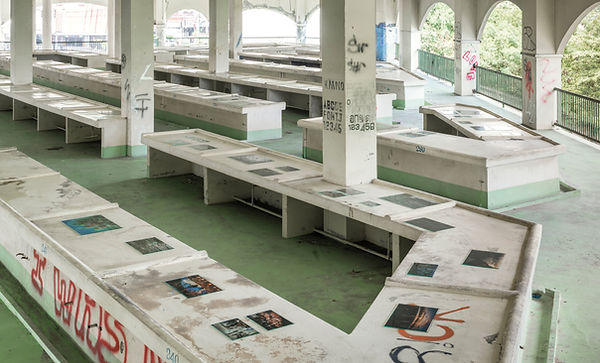
In an abandoned fresh market building structure in Phuket, originally planned as a site of commerce and more recently used as an improvised shelter for transient communities experiencing different forms of housing precarity, Phinthong presents The Sound of Birds. This multi-channel sound work mimics the calls of swiftlets—birds whose nests are commercially harvested for human consumption. Drawing on his brother’s experiences in the northeastern rice belt during COVID-19, where empty commercial units were repurposed into birdhouses, the artist reimagines this architectural skeleton as a large-scale, market-sized nest. Hundreds of temporary wooden joist structures are installed into the ceiling niches of the upper floor, along with audio lures that invite swiftlets to settle and thrive.
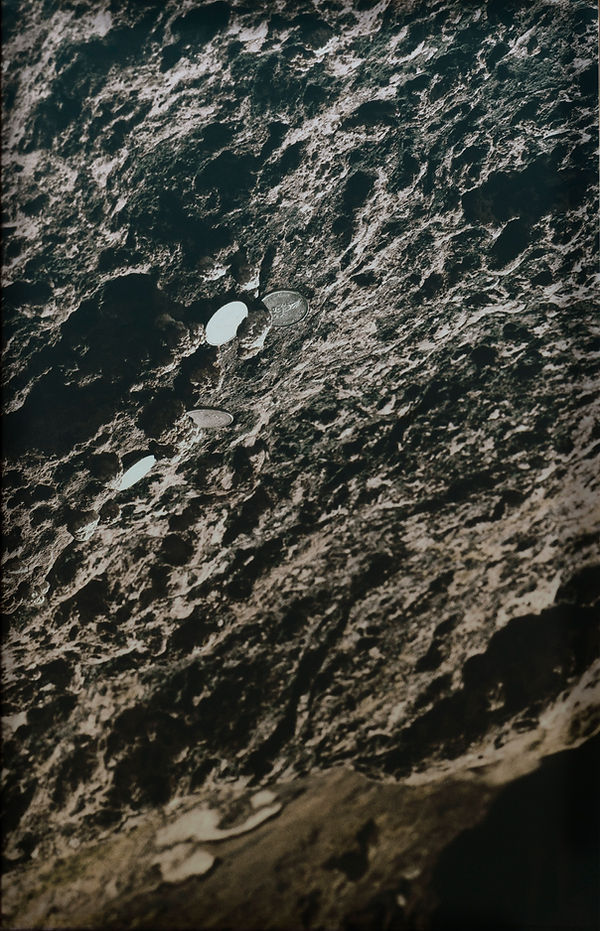
In parallel, The Sound of Coral Reefs involves broadcasting underwater recordings of healthy reef ecosystems into an ailing coral reef. Recent research by marine biologists indicate that fish larvae and aquatic life are drawn to these reef soundscapes—in particular, the sound made when healthy reefs release their eggs. Scientists believe the sound accelerates coral reef regeneration. By transmitting these healthy sonic environments to degraded reefs off the coast of Phuket, Phinthong activates a new form of ecological ventriloquism, where art becomes a medium for environmental revival.
water~copy ~air~streak is a project populated by skeletons: a concrete ruin, minimal wooden structures, and a dying reef. Each represent scaffolds for potential life. Sound is both invitation and intervention; a medium through which the artist works beyond the visual, and across water, air, species boundaries.
Phinthong’s project is engaged in the redistribution of the artistic resources made available through water~copy ~air~streak into scientific and environmental systems, while leaving the project open-ended. The artist has sought to develop forms of support for the pre-existing communities of the building for the duration of the Biennale, while the nesting habitat structures on the upper floors will be left in situ after the Biennale closes as an ongoing invitation to future swiftlet inhabitation. Acting as an artist, researcher, observer and amateur, Phinthong pushes beyond disciplinary limits to consider an ethics of shared environments and interspecies collaboration.
Mason Leaver-Yap
Credits for the Project Thailand Biennale 2025
Irin Siriwattanagul (sp/n)
Nathaphon Phantounarakul (sp/n)
Miles Parsons
Steve Simpson
Alex Dobson
Pitaluk Suwannadidtagul
Lalita Wongbusarakhum
Shin Sirachai Arunrugstichai
Tanatchai Bandasak
Mary Pansanga
Atit Sornsongkram
Supasit boonphienphol
Je Teng Complex
Faculty of Forestry, Kasetsart University
Phuket Marine Biological Center
Hat Noppharat Thara - Mu Ko Phi Phi National Park
Protected Areas Regional Office 5
Sarakorn Rujirawannakorn
Wilawan Ruangwarapith
Siwakorn Kittivorakul
ขอขอบคุณ
ไอศ์ริน สิริวัฒน์ธนกุล (เอสพีไอเอน)
ณัฐพล พันธุนรากุล (เอสพีไอเอน)
ไมล์ พาร์สัน
สตีฟ ซิมป์สัน
อเล็กซ์ ด็อปสัน
ปิตลักษณ์ สุวรรณะดิษฐกุล
ลลิตา วงศ์บุษราคัม
ศิรชัย อรุณรักษ์ติชัย (ชิน)
ธณัฐชัย บรรดาศักดิ์
แมรี่ ปานสง่า
อธิษว์ ศรสงคราม
นายศุภะสิทธิ์ บุญเพียรผล
หยี่เต้งคอมเพล็กซ์
คณะวนศาสตร์ มหาวิทยาลัยเกษตรศาสตร์
ศูนย์วิจัยทรัพยากรทางทะเลและชายฝั่งอันดามันตอนบน อุทยานแห่งชาติ หมู่เกาะพีพี
ส่วนอุทยานแห่งชาติ สำนักบริหารพื้นที่อนุรักษ์ที่ 5
สรากร รุจิราวรรณกร
วิลาวัณย์ เรืองวราพิชญ์
ศิวกร กิตติวรกุล